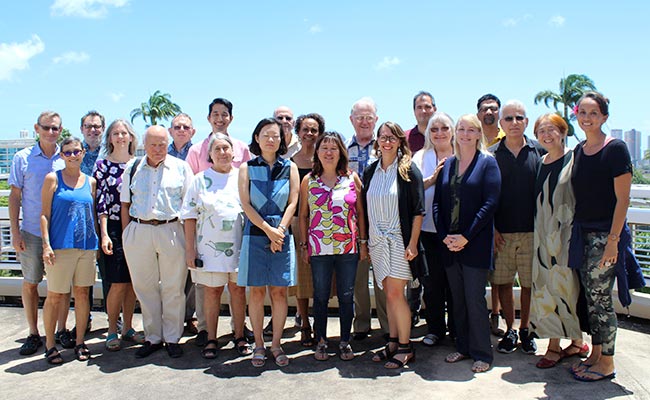
Assistant Professor Noelani Goodyear–Ka‘ōpua

Background
Noelani Goodyear-Ka‘ōpua is a Kanaka ‘Ōiwi who was born and raised in Hawai‘i. She earned her BA in Political Science and Hawaiian Studies from UH Mānoa before completing her PhD at the University of California, Santa Cruz in History of Consciousness. As an associate professor of Indigenous and Hawaiian politics, Noelani teaches courses in Hawai‘i politics, Indigenous politics, and decolonial futures. She also currently serves as the undergraduate chair of the Political Science department.
The ethics and practices of aloha ‘āina guide her academic and community work, as she seeks to document, analyze and proliferate the ways people are transforming imperial and settler colonial relations by mobilizing Indigenous political values and processes. For example, her research has focused on the politics of designing and implementing Native Hawaiian culture- and land-based educational initiatives within and against settler state structures. Her book, The Seeds We Planted: Portraits of a Native Hawaiian Charter School (University of Minnesota Press, 2013), discusses some of these tensions and the ways educators and students navigate them. Noelani also teaches and writes about Indigenous social movements, participatory & activist research methods, and Hawaiian sovereignty. Her second book, Ea: Hawaiian Movements for Life, Land and Sovereignty (Duke University Press, forthcoming), is a collection co-edited with Ikaika Hussey and Kahunawai Wright that explores late-20th and early 21st century Hawaiian organizing for justice and self-determination. More recently, she has also become interested in the intersections of energy and food politics with Indigenous social and political health.
Research Interests
My current research projects include a book project on the politics of Hawaiian education, from the 19th century to the present, and a video oral history project gathering stones of Hawaiian land struggle. I am deeply interested in Native–designed and controlled systems of governance and education; indigenous and participatory research methods; and community–based sustainable food and water projects.
Courses Taught
Hawai‘i Politics (POLS 301)
This course in Hawai‘i politics focuses on major institutions that have shaped island life over the last two centuries. Throughout the course, we will investigate the intersectionalities of power that operate through the various institutions we engage. This strong grounding in historical context provides class participants with a foundation for developing their own analyses on contemporary issues. The course is grounded in Native Hawaiian perspectives, but it draws on a range of voices and emphasizes constructive dialogue between indigenous and settler perspectives. Our understanding of Hawai‘i Politics is further deepened by comparison with parallel issues and phenomena in the wider Oceania (Pacific Islands) region. Topics include: government, education, land, water, energy, food, race and class.
Fall 2012 POLS 301 Syllabus [PDF]
Native Hawaiian Politics (POLS 302)
This course provides a critical study of issues in contemporary Native Hawaiian politics, with an emphasis on application and active engagement. This semester, Spring 2013, we will be focusing on four key areas that impact Hawaiian lands and communities in the present: land use, sovereignty, education, and energy. Within these broad areas, students will be able to select issues that are particularly meaningful to them and to their communities for more in-depth study.
Spring 2013 POLS 302 Syllabus [PDF]
Indigenous Politics (POLS 304)
Through this course, participants will develop our collective and individual understandings of the field of indigenous politics, particularly as articulated by indigenous political leaders and intellectuals. According to the United Nations Permanent Forum on Indigenous Issues, there are over 370 million indigenous people in over 70 different countries. We will not be able to fully survey this diversity, but you will get a sense of the breadth and dynamism of the issues and movements that constitute this political field. We will read and talk about how leaders constitute a common global indigenous agenda, while also advocating for locally–situated movements. We will begin by grounding ourselves in contemporary Kanaka Maoli issues here in Hawai'i Nei and then move outward to consider selected indigenous nations of Oceania and the Americas. We will consider the way a global network of indigenous political movements has coalesced since the late twentieth century, and we will discuss historical and contemporary entanglements between indigenous peoples and states. As we zoom in to focus on the political struggles of the Haudenosaunee, the Zapatistas, the indigenous peoples of Micronesia, Samoa and Hawai‘i, we will specifically engage questions of sovereignty, land usage, and indigenous forms of governance.
Fall 2009 POLS 304 Syllabus [PDF]
Political Inquiry and Analysis (POLS 390)
An introductory survey and analysis of methods used in empirical research related to politics. This section focuses on qualititative research methods, with an emphasis on ethnography, oral history and social criticism. Students conduct original research using these methods as part of the requirements for this course.
Fall 2009 POLS 390-003 Syllabus [PDF]
Introduction to Indigenous Politics (POLS 620)
This course provides an introduction to the genealogical, activist and academic concerns of the field of Indigenous Politics, particularly as it is taught within this particular location--UH Mānoa. It is also an International Cultural Studies Certificate (ICSC) Program Graduate elective course. You should leave the course with an understanding of some of the main trajectories that Native & Indigenous Studies have followed over the last four decades, as well as the key concepts that inform the field today. These include: indigenous/indigeneity, colonialism, settler colonialism, heteropatriarchy, survivance, sustainable self-determination, aloha ‘āina, wasase, recognition/reconciliation, resurgence, and anarcha-indigenism, to name a few.
Fall 2012 POLS 620 Syllabus [PDF]
Contemporary Native Hawaiian Politics (POLS 684)
What is the state of ‘the Hawaiian movement’? What visions, ethics, and strategies define Kanaka politics in the 21st century? These essential questions provide a springboard for this course. Our discussions and readings will be organized around five areas in the landscape of contemporary Native Hawaiian politics: land, education, governance, militarization/demilitarization, and cultural identity. In each section, we will investigate both historical contexts and a range of current issues. This includes, but is not limited to, the Native Hawaiian Government Reorganization Act (popularly known as “the Akaka Bill”), 'Aha Moku councils as state resource management reform, and Hawaiian public charter schools. As a group, we will develop our thinking about contemporary Kanaka politics by utilizing Hawaiian concepts to ground our analytical and ethical explorations. For example, how do concepts like ‘ea’, ‘lāhui’, or ‘kuleana’ offer forms of political analysis and practice that allow us to understand and imagine different ways of thinking and practicing politics in Hawai'i?
Spring 2012 POLS 684 Syllabus [PDF]
Politics of Hawai'i (POLS 686)
Land, Water, Sex, and Identity in Hawai'i
In the Hawaiian language, the word “ai” can variously refer to the acts of eating, sex, or rule. We take these various forms of ai/'ai as pathways through which to think about the power–laden relationships constituting the political, economic and cultural terrains of Hawai'i, past and present. We will pay particular attention to 'āina (land), wai and kai (fresh water and sea water). Kanaka Maoli have long studied and celebrated the interdependent relationships of kanaka and our non–human relatives, and we have recognized these mutually dependent relationships through protocols and philosophies around food, reproduction and governance. By considering acts of ai/'ai as culturally and historically–situated, this course examines intersections of place, gender, class, race, and identity. Considering the human oppression and environmental destruction that has taken place in Hawai'i over at least the last 150 years, we will discuss and envision ways our collective social and political lives may need to change in the coming decades.
Seminar: Indigenous Theory (POLS 720)
According to Jeff Corntassel, "Being Indigenous today means engaging in a struggle to reclaim, regenerate and continually renew one’s relational, place-based existence, in opposition to the ongoing, destructive forces of colonization and capitalism." Fundamental to renewing our relationships is the restoration of indigenous knowledge systems and practices as well as acknowledging and accepting one’s responsibility and authority to care for the land, water, community, and ancestors. In the Hawaiian language we call this kuleana. This course takes a broad brush-stroked look at the process of regenerating indigenous knowledge systems, our land based and water based practices, and the kuleana associated with this renewal and restoration process. Arguably, one of the biggest challenges we face in Hawai‘i as we work to regenerate our indigenous knowledge systems and land and water based practices is the US military industrial complex. Kyle Kajihiro describes the US military as a giant he‘e (octopus) whose body sits atop Hawai‘i and whose tentacles extend across the Pacific affecting everything in its path. This course will focus on the intersection of these two endeavors – first we will begin by establishing a shared understanding of indigeneity as a concept, a political identity, and a place from which theory is produced. We will then move into a more sustained look at the various ways indigenous scholars approach the production of indigenous theory.
Spring 2012 POLS 720 Syllabus [PDF]
Decolonial Futures (POLS 777)
What futures are indigenous peoples envisioning to replace colonial/neocolonial relations? In what ways does invoking the figure of ‘the indigenous’ in representations of the future retrench oppressive dynamics of power? What roles can scholars play in both the critique and creation of alternative futures? What political, economic and cultural tools or models exist already? These essential questions provide a springboard for this course, in which “decolonial” will not be limited to thinking about formal processes for decolonization under international law. Rather, we will try to imagine worlds beyond states and capitalism. We will look at the ways representations of indigenous pasts and futures come together in various proposals for a better world. Our discussions and readings will be centered on Oceania.
Spring 2011 POLS 777 Syllabus [PDF]