Skip navigation.

Political Science >

Sankaran Krishna

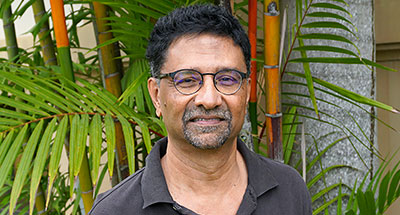
Picture of Professor Sankaran Krishna


Background: I grew up in an India where movies still began with a Films Division documentary heavy with the theme of development and ended with the national anthem. My high school finals in Madras coincided with the defeat of Mrs Gandhi’s Congress party in the parliamentary elections of 1977 and the resounding rejection of the Emergency. I did my Bachelor’s from Loyola College (majoring in Chemistry), and my Master’s from the Center for Historical Studies at Jawaharlal Nehru University in Delhi. I came to the United States in 1983, and took my doctorate in political science from the Maxwell School at Syracuse University in upstate New York. After a two-year visiting appointment at nearby Colgate, I joined Manoa in 1990 and have been here since. I enjoy reading, especially south Asian writing in English, playing tennis, and hanging out on the beach when I can. I am a life-member of the world’s largest club of the perennially disappointed – the Indian cricket fan – and firmly believe that behind every sub-continental academic lies a failed cricketer. I look forward to many years with my affable colleagues in one of the loveliest places on this planet.

Research Interests: My work so far has centered on nationalism, ethnic identity and conflict, identity politics, and postcolonial studies, located primarily around India and Sri Lanka. I am currently working on some essays dealing with the partition of the Indian subcontinent in 1947, the culture of Indian foreign policy making, the silent presence of race in discourses of international relations, diasporic forms of Indian nationalism, and other eclectic topics.

Selected publications:

Books:

Globalization and Postcolonialism: Hegemony and Resistance in the 21st Century, Lanham, MD: Rowman and Littlefield, 2009.

Postcolonial Insecurities: India, Sri Lanka and the Question of Nationhood, Minneapolis: University of Minnesota Press, 1999. (New Delhi: Oxford University Press, 2000).

Articles:

"The Social Life of a Bomb: India and the Ontology of an 'Overpopulated' Society," in Itty Abraham (ed.) South Asian Cultures of the Bomb: Atomic Publics and State in India and Pakistan, Bloomington: Indiana Univeristy Pess, (2009).

"The Bomb, Biography, and the Indian Middle Class," Ecomonic and Political Weekly, Vol. XLI, No. 23 (June 10, 2006), Mumbai, India.

"Maps," in Ashis Nandy and Vinay Lal, eds., The Future of Knowledge and Culture: A Dictionary for the 21st Century, New Delhi: Viking-Penguin, (2005): 163-168.

"Boundaries in Question," in John Agnew, Katharyne Mitchell and Gerard Toal (eds.), A Companion to Political Geography, London: Blackwell (2003): 302-314.

"An Inarticulate Imperialism: Dubya, Afghanistan and the American Century" in Alternatives: Turkish Journal of International Affairs, vol.1, no. 2, Summer 2002.

Methodical Worlds: Partition, Secularism, and Communalism in India, Alternatives 27, 2 (2002): 217-242. A Special Issue on "Partition" edited by Sankaran Krishna and R.B.J. Walker.

In One Inning: National Identity in Post-Colonial Times, Geeta Chowdhury and Sheila Nair (eds.), Power, Postcolonialism and International Relations: Reading Race, Gender and Class (London and New York: Routledge Press, 2002): 170-183.

Armed Struggle as a Metaphor in the War Against Terrorism, Theory and Event 5, 4 (2002). Special Issue "Reflections On September 11th, 2001." Co-authored with Neal Milner and Kathy Ferguson. (http://muse.jhu.edu/journals/theory_and_event/v005/5.4ferguson_01.html)

Race, Amnesia and the Education of International Relations, Alternatives 26, 4 (2001): 401-424.

Divergent Narratives: Dravidian and Tamil Eelamist Nationalisms, Michael Roberts (ed), Collective Identities Revisited, Volume II. Colombo: Marga Press, 1998): 315-346.

Cartographic Anxiety: Mapping the Body Politic in India, Hayward Alker Jr. & Michael Shapiro (eds.),
Challenging Boundaries: Global Flows, Territorial Identities (Minnesota, 1996): 193-215.

The Importance of Being Ironic: A Postcolonial View on Critical International Relations, Alternatives 18, 3 (1993): 385-417.

William Connolly, The Ethos Of Pluralization (Minneapolis: University of Minnnesota Press, 1999). Reviewed for Theory and Event 5,4 (2002). (http://muse.jhu.edu/journals/theory_and_event/v005/5.4krishna.html)

Selected Courses taught:

POLS 740: Seminar on "Politics, Economics, and the State"

Course Description: "What's good for General Motors is good for the country and vice versa," said Charles E. Wilson back in the 1950s when he was the President of General Motors, the Detroit-based automobile manufacturer and one of the world's largest firms. This famous quote was emblematic of an era in which the interests of the "average" American dovetailed neatly with those of its premier capitalist firms and managers. In their heyday, firms like GM attributed their global success to their efficiency, ability to innovate, and to out-compete everyone else in a fair and free market. They argued the ideal economy was one untrammeled by state interference and 'politics' ought to stay out of the economy. Today, the head of GM - along with those of Ford and Chrysler - is in Washington DC, pleading with Congress to avert the imminent bankruptcy and collapse of his firm. The big three American automakers seek a federal bailout and request a period of protection during which they can innovate newer, and more fuel-efficient hybrid cars that will help them regain their market share. The 'state' has suddenly transformed from an interfering and negative presence in the logic of a free economy to a necessary benefactor to ensure the survival of GM, and more generally, to ensure America's recovery from one of its worst economic recessions. That Wilson went on to become Secretary of the Department of Defense ought to immediately indicate that for all the talk of the necessary autonomy of the market from the state, even at the apex of American hegemony over the world it was always more a fiction than a reality, but fictions are often far more powerful and enduring than the term indicates. Amidst today's swirling crisis of the United States - indeed the global - economy, we see the centrality of the state and of political intervention for the functioning of so-called free markets and of capitalism. This course examines the interaction between the domain of the 'economy' and 'politics' in historical and centemporary times.

We will look at a series of readings that problematize this analytical distinction between the domains of politics and economics - with most beginning from the view that this distinction is itself a quintessentially political moment. From there we move onto books that critically examine the issue of development, industrialization and economic growth in the periphery and semi-periphery of the world economic system - all of which demonstrate the centrality of the state to the developmental success or failure of such countries. We next turn to the ways in which the until-recently ascendant ideology of neoliberalism stratifies class and society in Southeast Asia, and how such an ideology is not merely an imposition from first world states and multilateral institutions but is powerfully internalized and utilized by third world peoples and classes as well. We then finally turn to a set of readings that analyze developmentalism as an ideology that is a part of regimes of governmentality and modernity, with powerful ethical implications for human being.

To put it differently, we focus on the following questions: What are the ethical and philosophical entailments of the distinction between politics and economics? How do modern liberal societies sustain the idea of democracy alongside that of economic inequality? What does it mean to engage in 'economistic' or economically reductionist reasoning and why is that bad? Are globalization and the freedom of markets inevitable, rational, or desirable? What are the ethics of presenting political intervention as detracting from economic efficiency? What does it mean to live in a world where the market decides optimality of investments and policies? Why is the 'moral hazard' argument applicable mainly to 'welfare queens' and homeowners unable to make their mortgage payments while it seems inapplicable to gian financial houses, investment banks, insurance agencies, and automobile manufacturers?

Course Readings: In the early weeks of the course, we will be reading a series of book-chapters and journal articles that have adopted a genealogical approach to the separation of 'economics' and 'politics' under the sign of modernity. We will thereafter read books that look at the wages of such separation in different geographical and temporal contexts. The readings and books we will be using are:

Excerpts from: Karl Polanyi, The Great Transformation; Pierre Bourdieu, Outline of a Theory of Practice; Karl Marx, On the Jewish Question; Jean Baudrillard, Towards a Critique of the Political Economy of the Sign; Walden Bello et al., Global Finance; Mike Davis, Late Victorian Holocausts; Naomi Klein, Shock Doctrine; Arjun Appadurai (ed.), The Social Life of Things; David Harvey, A Very Short History of Neoliberalism.

Books:
Robert Wade, Governing the Market: economic theory and the role of government in East Asian industrialization (Princeton, 2003).
Atul Kohli, State Directed Development: political power and industrialization in the global periphery (Cambridge, 2004).
Ha-Joon Chang, Bad Samaritans: the myth of free trade and the secret history of capitalism (Bloomsbury, 2007).
Anan Tsing, Friction: an ethnography of global connections (Princeton, 2005).
Aihwa Ong, Neoliberalism as Exception: mutations in citizenship and sovereignty (Duke, 2006).
Timothy Mitchell, Rule of Experts: Egypt, Technopolitics, Modernity (California, 200).

Comparative Politics (POLS 305): Global and Asia-Pacific Politics: A Comparative Approach: This mandatory course examines the global and inter-related nature of political and economic development over the last few centuries. The approach taken regards the emergence of the western first-world and the non-western third world as inter-related and connected processes. It emphasizes questions such as: what have been the historical relationships between the developed, capitalist countries of this world and those in the third world; what has been the record of economic development, political change, and social and individual freedoms in the western and non-western worlds; what have been the impacts of various economic developmental strategies and models on various sections of the populations of first and third world countries; how does the history of Hawaii reflect the history of capitalism and colonialism in the last two centuries.

The following texts are required for this course.

  • Kevin Bales, Disposable People: new slavery in the global economy, California, 1999;
  • Michael Burawoy et.al., Global Ethnography: forces, connections, and imaginations in a postmodern world, California, 2000;
  • Cynthia Enloe, Bananas, Beaches and Bases: making feminist sense of international politics, California, 1989;
  • Milton Murayama, All I Asking For Is My Body, Hawaii, 1988;
  • Walden Bello et.al., Global Finance: new thinking on regulating speculative capital, Zed, 2000.

Comparative Politics (POLS 640): The Material Economies of Globalization: This course attempts to understand the contemporary discourse on Globalization against a longer, historical frame-work that emphasizes international political-economy, western expansion, colonial conquest, and the emergence of modernity on a world-scale. Broadly, it sees the recent acceleration in the mobility of capital, the consequent space-time compression, and the various political, economic, cultural and social manifestations of these changes, as part of a longer historical process that emerged in 1492 with the discovery of the new world by Columbus, and was thereafter marked by the gradual consolidation of planet-wide system of production for the market and for exchange. In other words, this course will look at global political-economy through both contemporary lenses and through works attendant to the five-century long narrative of emerging modernity.

This course is anchored around the following books:

  • Mark Rupert, Ideologies of Globalization: contending views of a new world order (Routledge, 2000);
  • Ankie Hoogvelt, Globalization and the Post-Colonial World: new political economy of development (Johns Hopkins, 1997);
  • David Scott, Refashioning Futures (Princeton, 1999);
  • Millennial Edition of Globalization: Public Culture (Duke, 2000),
  • Frederic Jameson and Masao Miyoshi (eds.), Cultures of Globalization (Duke, 1998),
  • Anthony King (ed.), Culture, Globalization and the World System (Minnesota, 1997).

In addition, I will list a number of other supplementary readings that constitute the intellectual context of the above books.

Comparative Politics (POLS 740): States, Citizens and Subjects: This graduate seminar in comparative politics focuses on the hyphen that links/separates "nation-state". It will examine the career of the nation in modern times - and its relationship to the various fragments that constitute both its supposedly retrogressive rivals (ethnicity, for instance) and the supplements that make the nation itself possible. We will read a selection of recent books and articles/ book chapters surrounding these themes to get a sense of the highly charged and contested terrain that constitutes the national question at this point in time.

The course will be anchored around the following books:

  • Mahmood Mamdani, Citizen and Subject: contemporary Africa and the legacy of late colonialism, Princeton, 1996;
  • James Scott, Seeing Like a State: how certain schemes to improve the human condition have failed, Yale, 1998;
  • Cynthia Enloe, Maneuvers: the international politics of militarizing women’s lives, California, 2000;
  • Sankaran Krishna, Postcolonial Insecurities: India, Sri Lanka and the question of Nationhood, Minnesota, 1999;
  • Benedict Anderson, Spectre of Comparisons: nationalism, Southeast Asia and the World, Verso, 1998.

Comparative Politics (POLS 740): Critical Comparative Politics: This seminar course takes a somewhat unconventional look at the sub-discipline of Comparative Politics. Until recent times, the field was dominated by a handful of schools or approaches: modernization theory, the dependency school, and world-systems analyses pretty much covered the range of theoretical frameworks used to analyze the politics of developing societies. In the last decade, however, such approaches have seemed increasingly inadequate in capturing a whole slew of developments: the collapse of the ‘socialist’ or communist bloc; the re-emergence of genocidal conflicts in the name of ‘ethnicity’; the vast increase in numbers of peoples classified as aberrations within the state-centric system (migrants, refugees, illegal aliens, prisoners of war etc.); the increasing sophistication and global reach of so-called guerrilla movements; a serious erosion of the state’s monopoly over the means of coercion; a dilution of state sovereignty in the face of accelerated global flows of finance, commodities, fashions and information, and so on. Rather than trying to restore the ‘normalcy’ of the field of comparative politics, this seminar focuses on readings that attempt to chart these new developments without being invested in older frameworks locked in a nationalist imaginary. One of the (unsurprising) results is that none of the books we will be looking at this semester emerge from comparative politics (or even political science) - and for that very reason allow us to engage in a critical and self-reflexive dissection of this discipline: what does it take for granted and what are the political consequences of such received wisdom?

Among our readings will be the following:

  • Liisa Malkki, Purity and Exile: violence, memory and national cosmology among Hutu refugees in Tanzania, University of Chicago, 1995;
  • Kathy Ferguson and Phyllis Turnbull, Oh, Say Can You See: the semiotics of the military in Hawaii, University of Minnesota Press, 1998;
  • Nicholas Dirks, ed., In Near Ruins: Cultural theory at the end of the century, University of Minnesota Press, 1998;
  • Nestor Garcia Canclini, Hybrid Cultures: strategies for entering and leaving modernity, University of Minnesota Press, 1995;
  • E. Valentine Daniel and John Knudsen, eds., Mistrusting Refugees, University of California Press, 1996;
  • Anne McClintock, Aamir Mufti and Ella Shohat, eds., Dangerous Liasions: gender, nation and postcolonial perspectives, University of Minnestoa Press, 1997;
  • Slavenka Drakulic, Balkan Express: fragments from the other side of war, W.W. Norton Press, 1993.

Comparative Politics (POLS 640): Nation/Ethnicity and Insecurity. This graduate course approaches the sub-discipline of comparative politics in a somewhat unusual way: it constitutes an intensive examination and critical deconstruction of the very concepts, categories and units of analysis that sub-discipline rests upon. We will undertake genealogical readings of ideas such as the nation, ethnic groups, national and ethnic identity, and try to see how they are mutually constitutive, how they produce and reproduce each other, and how they together combine to create the current politics of insecurity in the global order. The ethic animating this course is one that does not take the current spatialization of our world as a given, but tries to be critical and reflexive about the emergence and consolidation of such a worlding. It is especially concerned with seeing how the modernist imaginary is one that relentlessly, and unsuccessfully, attempts to endow every unit of territory with a uniform, pulverized, and singular notion of identity.

The following books will anchor the course:

  • Allen Feldman, Formations of Violence: the narrative of the body and political terror in Ireland. (Chicago 1991);
  • Michael Taussig, The Magic of the State. (Routledge 1997);
  • David Campbell, National Deconstruction: Violence, Identity and Jusice in Bosnia. (Minnesota, 1998);
  • Akhil Gupta, Postcolonial Developments: agriculture in the making of modern India, (Duke, 1998);
  • James Scott, Seeing Like a State: how certain schemes to improve the human condition have failed. (Yale, 1998);
  • Michael Dillon, The Politics of Security: towards a political philosophy of continental thought. (Routledge, 1997).