
Indigenous Politics
As a departmental specialization, we created the Indigenous Politics Program (UHIP) to transform the ways political science and the University historically related to Indigenous peoples and lands. We aim to nurture students who will engage in a critical praxis of Indigenous politics by training them to think politically, read fields of power, and build skills that will allow them to engage the world around them. To make the boundaries of the University more porous, we cultivate partnerships with community organizations and other academic programs. We attend especially to our place in Hawaiʻi and the regions of Oceania and Asia.
- Visit the Indigenous Politics Program website
Core Faculty
Affiliate/Cooperating Faculty
- Noelani Arista - Associate Professor, History, UH Mānoa
- Malia Akutagawa - Assistant Professor, Law, UH Mānoa
- Rosie Alegado - Associate Professor, Oceanography and Sea Grant, UH Mānoa
- Leilani Basham - Associate Professor, Hawaiian Studies, UH Mānoa
- Kamana Beamer - Associate Professor, Hawaiian Studies, UH Mānoa
- Marie Alohalani Brown - Assistant Professor, Religion, UH Mānoa
- Patricia Amaral Buskirk - Assistant Professor, Communications, UH Mānoa
- Kimo Cashman - Faculty Specialist, Curriculum Studies, College, Education, UH Mānoa
- Kahikina de Silva - Assistant Professor, Hawaiian Language, UH Mānoa
- Kathy Ferguson - Professor, Political Science, UH Mānoa
- Cynthia Franklin - Professor, English, UH Mānoa
- Candace Fujikane - Associate Professor, English, UH Mānoa
- Jonathan Goldberg-Hiller - Professor, Political Science, UH Mānoa
- Ulla Hasager - Associate Specialist, Director, Civic Engagement, UH Mānoa
- Vilsoni Hereniko - Professor, Film in the Academy, Creative Media, UH Mānoa
- Kuʻualoha Hoʻomanawanui - Associate Professor, English, UH Mānoa
- Craig Howes - Professor, English, UH Mānoa
- Tarcisius Kabutaulaka - Associate Professor, Pacific Island Studies, UH Mānoa
- Lilikala Kameʻeleihiwa - Professor, Hawaiian Studies, UH Mānoa
- Julie Kaomea - Professor, Curriculum Studies, UH Mānoa
- Kekeuwa Kikiloi - Assistant Professor, Pacific Islands History, UH Mānoa
- Noa Lincoln - Assistant Professor, Tropical Plant and Soil Science, UH Mānoa
- Melody MacKenzie - Professor, Law, UH Mānoa
- Brandy Nalani McDougall - Associate Professor, American Studies, UH Mānoa
- Davianna McGregor - Professor, Ethnic Studies, UH Mānoa
- Laurel Mei-Singh - Assistant Professor, Ethnic Studies, UH Mānoa
- Katrina-Ann Kapa Oliveira - Professor, Hawaiian Language, UH Mānoa
- Jon Kamakawiwoʻole Osorio - Dean, Hawaiian Studies, UH Mānoa
- Craig Santos Perez - Assistant Professor, English, UH Mānoa
- Noelani Puniwai - Assistant Professor, Hawaiian Studies, UH Mānoa
- Marie Kainoa Fialkowski Revilla - Assistant Professor, Human Nutrition, UH Mānoa
- Noukahau'oli Revilla - Assistant Professor, English, UH Mānoa
- Nevzat Soguk - Professor, Political Science, UH Mānoa
- Kapuaʻala Sproat - Professor, Law, UH Mānoa
- Ty Kawika Tengan - Associate Professor, Anthropology & Ethnic Studies, UH Mānoa
- Lani Teves - Assistant Professor, Women's Studies, UH Mānoa
- Mehana Blaich Vaughan - Assistant Professor, Natural Resources and Environmental Management, UH Mānoa
- Joyce Pualani Warren - Assistant Professor, English, UH Mānoa
- Erin Kahunawai Wright - Assistant Professor, Educational Administration, UH Mānoa
- Laiana Wong - Professor, Hawaiian Language, UH Mānoa
Related Courses
- POLS 140: Introduction to Indigenous Politics
- POLS 301: Hawai‘i Politics
- POLS 302: Native Hawaiian Politics
- POLS 303: (Alpha) Topics in Hawai‘i Politics
- POLS 304: Indigenous Politics
- POLS 309: Politics of Indigenous Language Revitalization
- POLS 403: Community Internship
- POLS 612: Hawaiian Political Thought: Theory and Method/Na Mana‘o Politika Hawai‘i
- POLS 620: Introduction to Indigenous Politics
- POLS 621: Politics of Indigenous Representation
- POLS 642: Indigenous Peoples and Western Imperialism
- POLS 684: Contemporary Native Hawaiian Politics
- POLS 686: Politics of Hawai‘i
- POLS 720: Seminar: Indigenous Theory
- POLS 776: Indigenous Nations and the Problems of Sovereignty
- POLS 777: Decolonial Futures
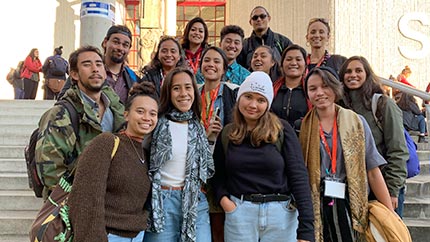
Mānoa Academy students and teaching assistants attend the NAISA conference in Hamilton, Aotearoa/New Zealand.
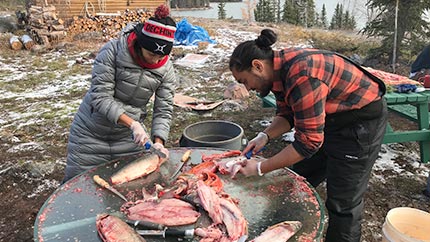
Professor Noelani Goodyear-Kaʻōpua and ʻĪmaikalani Winchester prepare food during an exchange in Victoria, British Columbia.
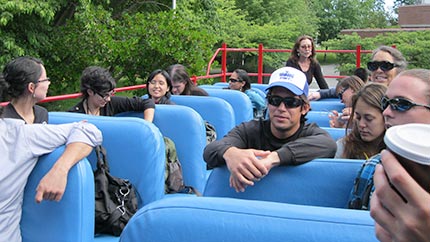
Students on the Indigenous Politics/Indigenous Governance exchange in Victoria, BC, are taken on an anti-colonial tour by Salish First Nation guide Cheryl Bryce. (photo by Kahealani Lono)
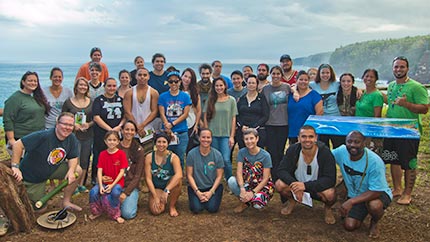
UHIP faculty and students participate in an exchange with University of Victoria Indigenous Governance students on Hawaiʻi Island.
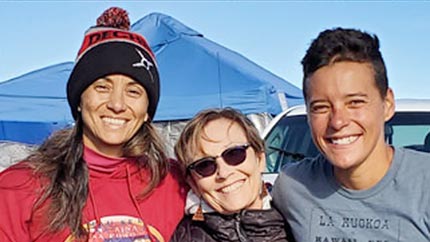
UHIP professors at Mauna Kea.
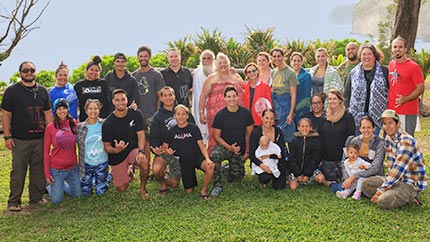
UHIP faculty and graduate students participate in a writing retreat with University of Victoria faculty as well as members of the Hāmākua community at Koholālele.
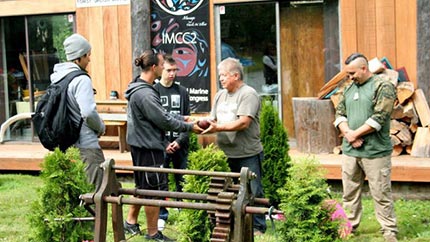
No`eau Peralto and Kaleo Wong, students participating in the Indigenous Politics/Indigenous Governance exchange in Victoria, British Columbia, present makana (gifts) to Salish artist Charles Elliot and his son. (photo by Kahikina de Silva)
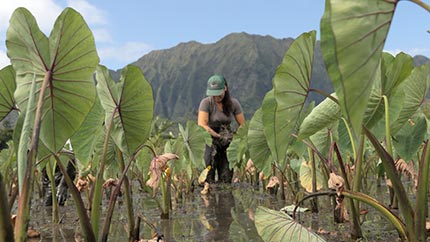
Student works in a loʻi, or wetland taro patch.